
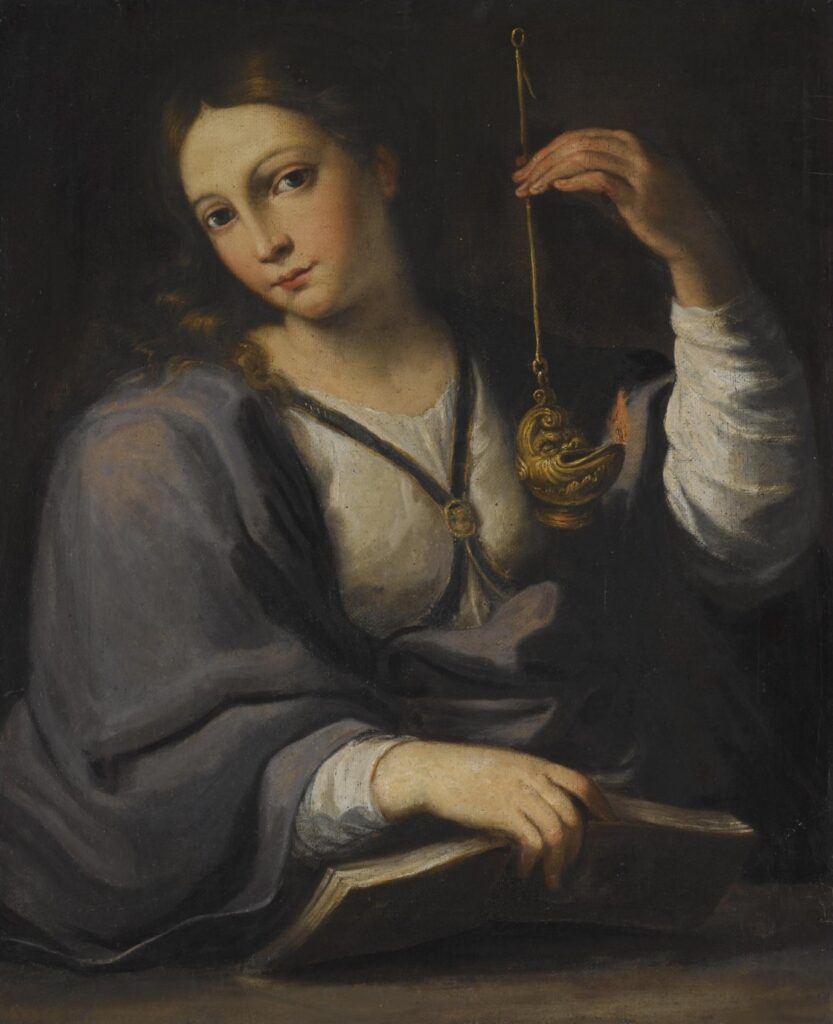
An allegory of wisdom, attributed to Giovanni Domenico Cerrini (1609–1681)
Phronesis and Virtue: Reflections from Gdańsk
I am a full-time maths teacher at an inner-city comprehensive school in Coventry, UK. For the past three years, I’ve also been doing a part-time MA in Character Education at the Jubilee Centre for Character and Virtues, University of Birmingham. So far, my research has focussed primarily on the role of rewards in character education, especially the controversial suggestion that rewards might be used to lure children into developing more autonomous motivation. In October 2025, I will begin a PhD (still at the Jubilee Centre) exploring whether this internalisation process might be accelerated through reflection informed by phronesis or ‘practical wisdom’. I was thrilled to present some of my ideas at the recent Phronesis in Theory and Practice conference at the Institute of Philosophy, University of Gdańsk – made possible thanks to a travel grant from the Philosophy of Education Society of Great Britain (PESGB).
This conference was significant for me both personally and professionally. It was my first international academic experience and a chance to meet my PhD supervisor in person. Moreover, I received early feedback on my research from leading scholars in the field – an invaluable opportunity before starting my doctoral work.
In my talk, I proposed several connections between the development of phronesis and the internalisation of virtue. I adopted my supervisor’s neo-Aristotelian model of phronesis, which includes moral perception, emotion regulation, a ‘blueprint’ for the good life, and adjudication between virtues (Kristjánsson & Fowers, 2024). As for virtue internalisation, I suggested that a virtue is internalised via its motivation component – specifically, as the motivation for its associated behaviours moves along the autonomy continuum proposed by Organismic Integration Theory (Ryan & Deci, 2017). For example, if a child is kind initially on the promise of rewards, but eventually comes to value kindness for its own sake, then this shift in motivation – from external to more autonomous regulation – would comprise an internalisation of virtue. I proceeded to explore how such a shift in motivation might influence the development of phronesis, and vice versa. For example, having a blueprint for the good life might encourage one to personally value behaviours that align with that blueprint. This raises some interesting educational questions, including: Should teachers explicitly aim to impart such a blueprint to their students?
During the Q&A session, one professor challenged my suggestion that virtue internalisation proceeds exclusively via motivation. He said that concepts and ideas could also undergo such a process. For example, when one first encounters an idea, it might be expressed in an alien technical language. In time, however, one might learn to express the concept in their own words – thus internalising it. I wholeheartedly agree, especially regarding the blueprint component of phronesis: children must be able to articulate their vision of the good life in their own words. As Paulo Freire said, ‘their way of speaking is as beautiful as our way of speaking’. However, understanding what it means to lead a good life is no guarantee that one will actually lead a good life – hence the famous “gappiness problem” in moral psychology (Kristjánsson & Fowers, 2024). I maintain that what bridges the gap between moral knowledge and moral action is motivation – sufficiently internalised motivation.
Another professor pressed me on what ignites the process of internalisation. Why would anyone take something in and make it their own? I had no clear answer. He pointed me towards Zagzebski’s (2017) exemplarist moral theory, which sees admiration as a key motivator for moral development. I have read little more than the blurb so far, but one question already springs to mind: How do we ensure that those we admire are moral exemplars? One need not look far for public figures who are greatly admired yet also vicious; some seem to be greatly admired because they are vicious. Others seem to be hated for their virtue. I look forward to exploring this further.
The same professor also cautioned me against merely engaging in ‘symbolic manipulation’. I consider this to be sage advice, especially given my background in mathematics. Often, I assign meaning or significance to various terms, before proceeding to shuffle those terms around a page according to the rules of logic and argument – assuming that the output will also be meaningful/significant. This assumption shouldn’t be taken for granted. As a research practitioner, it is important to develop the habit of bringing one’s ideas and abstractions back down to earth – to the school, to the classroom. An idea might be interesting, but who is it going to help? Whose life is it going to make better? Thankfully, I have found students to be quite good at keeping their teachers grounded.
I’m deeply grateful to the PESGB for making this experience possible. The conference affirmed my desire to bridge philosophy and practice in education.
References
Kristjánsson, K., & Fowers, B. (2024). Phronesis: Retrieving practical wisdom in psychology, philosophy, and education. Oxford University Press.
Ryan, R. M., & Deci, E. L. (2017). Self-determination theory: Basic psychological needs in motivation, development, and wellness. Guilford Press. https://doi.org/10.1521/978.14625/28806
Zagzebski, L. T. (2017). Exemplarist moral theory. Oxford University Press.
